Best Portable Cooking Utensils for Camping
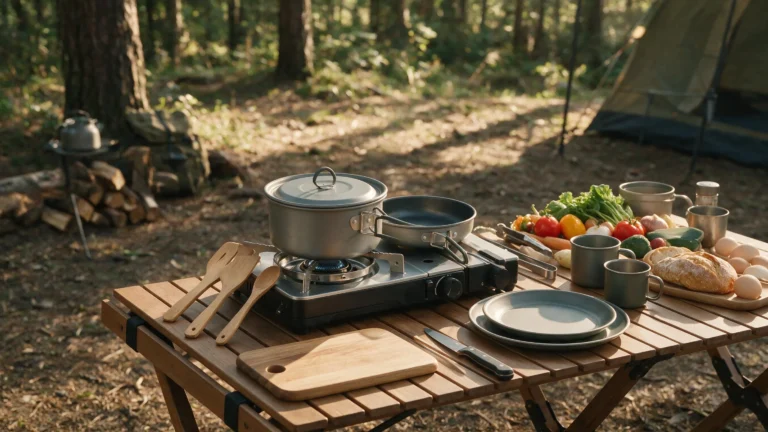
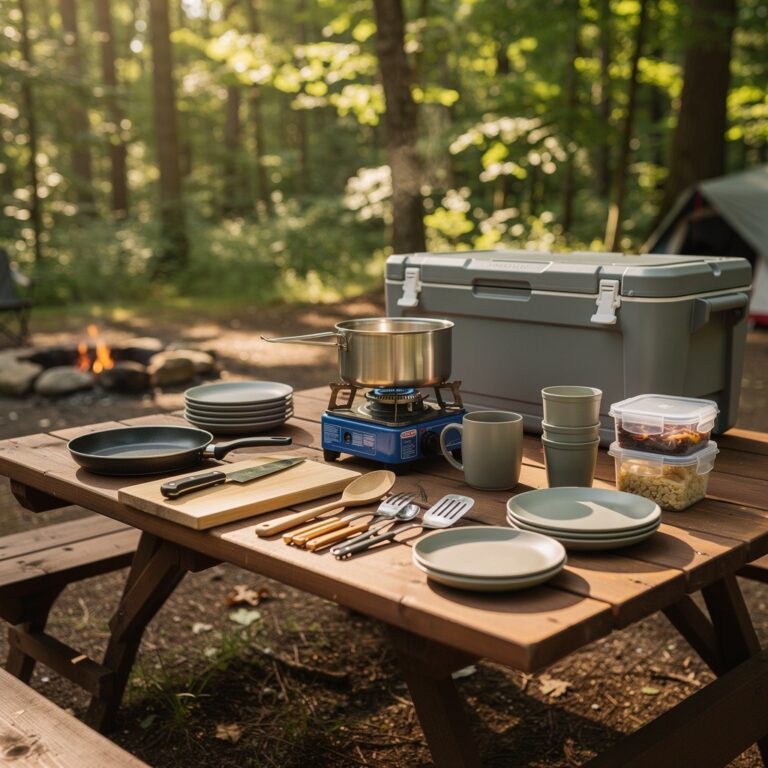
Cooking at a campsite can be simple and enjoyable when you have the right utensils. Unlike a home kitchen, a camping kitchen has limited space, so every tool needs to earn its place in your cooking bag.
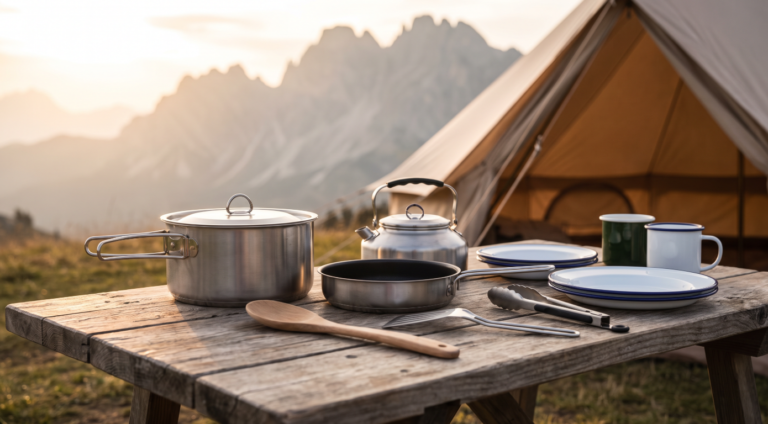
The best portable cooking utensils for camping are lightweight, durable, easy to clean, and versatile enough to handle several different tasks. Whether you are preparing breakfast at a campsite, cooking dinner over a portable stove, or making a quick meal during a road trip, a small collection of practical utensils can make outdoor cooking much easier.
In this guide, we will look at the best types of portable cooking utensils to pack for camping and explain what to consider when choosing them.
What Makes a Good Camping Cooking Utensil?
Before choosing specific utensils, think about how you will use them.
A good camping utensil should ideally be:
- Lightweight
- Compact
- Durable
- Easy to clean
- Easy to store
- Comfortable to use
- Suitable for outdoor cooking
- Versatile enough to perform more than one task
For backpacking trips, weight and packability are especially important. For car camping, you generally have more freedom to bring larger or more complete cooking tools. REI recommends considering your camping style, cookware needs, materials, weight, and storage space when choosing camping cookware and kitchen equipment.
1. Camping Spatula
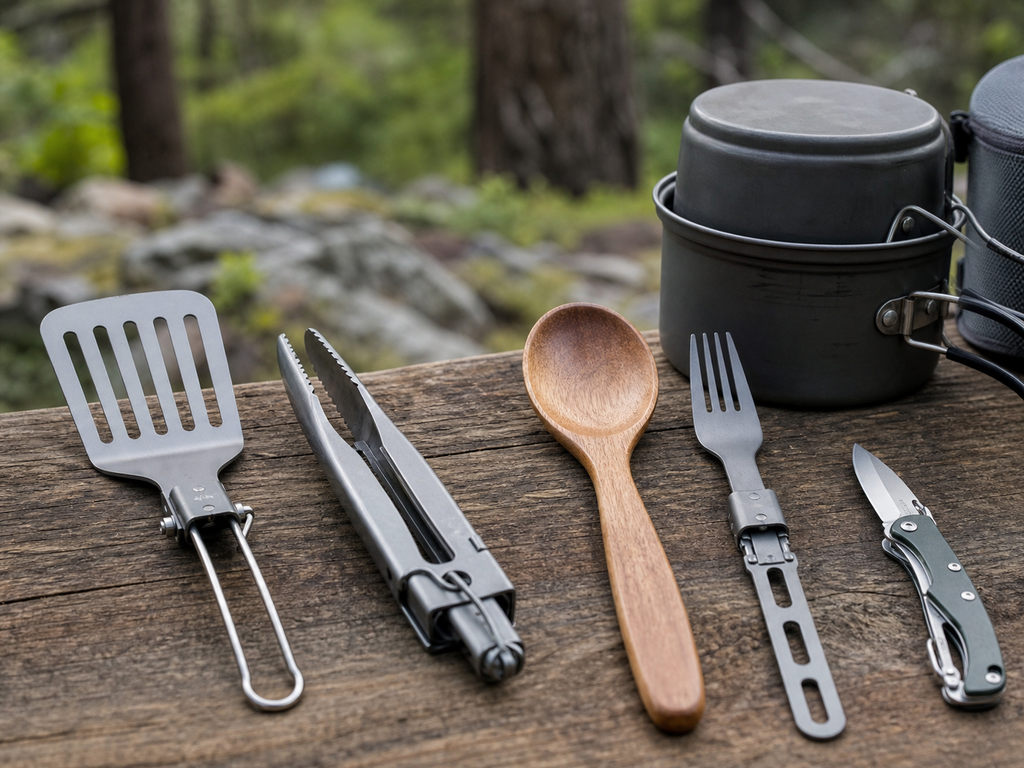
A compact spatula is one of the most useful cooking utensils you can bring camping.
You can use it to:
- Flip eggs
- Turn pancakes
- Move vegetables
- Flip burgers
- Cook fish
- Scrape food from a pan
Choose a small spatula that is strong enough for outdoor cookware but compact enough to fit inside your cooking kit.
A folding spatula can be particularly convenient because the handle takes up less space when packed.
2. Camping Cooking Spoon
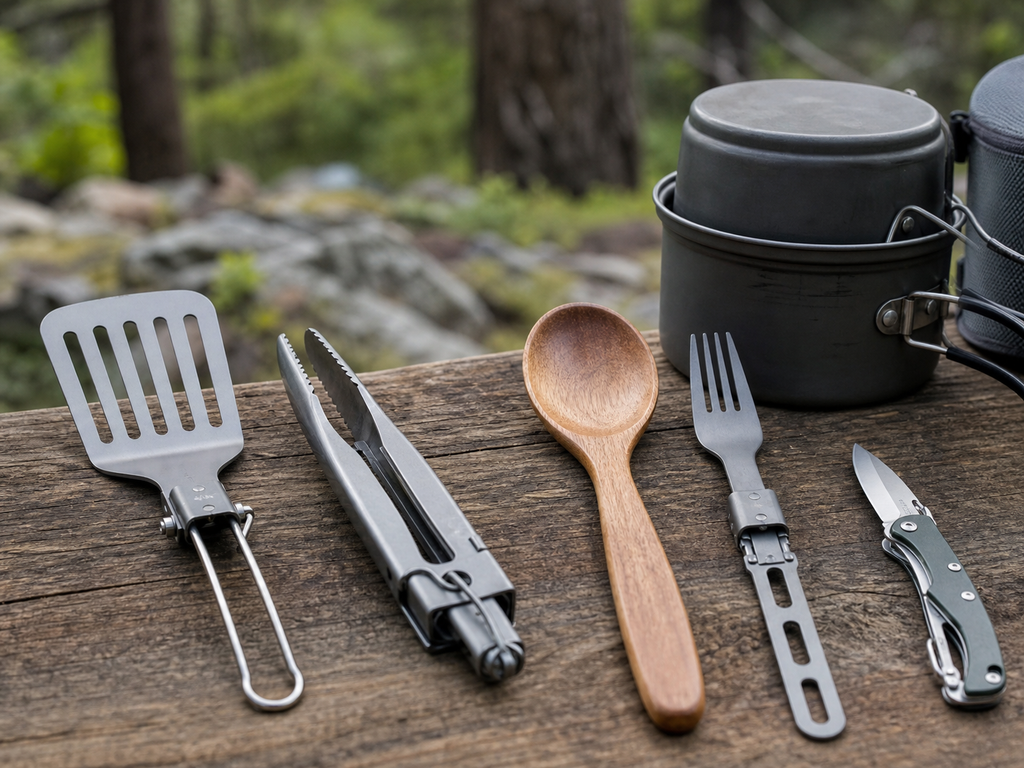
A cooking spoon is another basic utensil that can handle many campsite meals.
Use it for:
- Stirring soups
- Mixing sauces
- Cooking rice
- Stirring pasta
- Serving food
- Mixing oatmeal
A wooden or heat-resistant silicone spoon can work well for many camping setups.
If you are using nonstick cookware, choose utensils that will not unnecessarily scratch the cooking surface.
You can also check out our guide to Best Nonstick Cookware Sets for Everyday Cooking for more information about choosing cookware for everyday meals.

3. Camping Tongs
A good pair of compact tongs can replace several other tools.
Tongs are useful for:
- Turning meat
- Flipping vegetables
- Serving food
- Handling hot ingredients
- Moving food around a pan
Look for tongs with a locking mechanism if possible. When closed, they are easier to store and take up less space.
For camping, stainless steel tongs with a comfortable grip can be a good option for general cooking.

4. Camping Knife
Although a knife is technically a food-preparation tool rather than a cooking utensil, it is an essential part of almost every camp kitchen.
A single reliable knife can handle:
- Vegetables
- Fruit
- Bread
- Cheese
- Meat preparation
- General food preparation
For most campers, one good knife is more practical than carrying a complete knife set.
Always transport your knife safely with a protective cover or sheath.
5. Compact Cutting Board
A cutting board pairs naturally with a camping knife.
Look for a board that is:
- Lightweight
- Small
- Durable
- Easy to wash
- Easy to store
Flexible or folding cutting boards can save valuable space.
If you are preparing raw meat, use appropriate food-safety practices and avoid using the same utensils or surfaces for raw and cooked foods without cleaning them properly. The USDA specifically recommends keeping raw foods separate and using clean utensils and preparation surfaces while camping.
6. Camping Spork
For minimalist camping, a spork can be one of the most useful utensils you can pack.
It combines a spoon and fork into one compact tool, reducing the number of items in your bag.
A spork works particularly well for:
- Pasta
- Rice
- Oatmeal
- Soup
- Freeze-dried meals
- Beans
- Simple one-pot meals
For backpacking, where every gram matters, combination utensils can be especially useful.
7. Portable Whisk
A whisk is not necessary for every camping trip, but it can be useful if you plan to prepare pancakes, eggs, sauces, or other recipes that require mixing.
Instead of bringing a full-size kitchen whisk, choose a compact camping whisk.
For very simple trips, you can also skip the whisk and use a fork for basic mixing.
The goal is to pack according to your menu rather than bringing every possible kitchen tool.
8. Camping Ladle
A small ladle is useful when preparing:
- Soup
- Chili
- Stews
- Sauces
- Large-batch meals
For solo camping, a ladle may not be necessary. However, it becomes more useful when cooking for a family or group.
If space is limited, choose a compact ladle or a cooking spoon that can also serve food.
9. Can Opener
A small manual can opener can be extremely useful if your camping meals include canned foods.
Canned tuna, beans, vegetables, soup, and other shelf-stable foods can be convenient for outdoor trips.
The USDA notes that shelf-stable foods can be practical for longer camping and backpacking trips because they do not require refrigeration.
Choose a compact can opener that fits easily inside your cooking kit.
10. Bottle Opener
A bottle opener is another small tool that can be useful during camping trips.
Some compact camping tools combine a bottle opener with other functions, helping reduce the number of separate items you need to pack.
If you rarely use one, however, there is no reason to bring it just because it is part of a large utensil set.
Always prioritize the tools that match your actual meals and activities.
11. Measuring Spoons
Measuring spoons can be useful when preparing recipes that require accurate amounts of spices, oils, sauces, or other ingredients.
For camping, choose:
- Nesting measuring spoons
- Lightweight materials
- Compact designs
- Easy-to-clean surfaces
If you are trying to reduce your camping gear, measure ingredients at home before your trip and pack them in small containers.
This can save both time and space.
12. Compact Measuring Cup
A measuring cup can be useful for recipes involving rice, pasta, pancake mixes, sauces, and drinks.
However, a full-size measuring cup can take unnecessary space in a small camping kitchen.
A collapsible measuring cup is a better option for campers who want the functionality without the bulk.
For backpacking trips, you may be able to skip it entirely by pre-measuring your ingredients before leaving home.
13. Portable Potato Masher
A potato masher is not an essential utensil for everyone, but it can be useful for campers who enjoy preparing mashed potatoes, beans, or similar foods.
If you plan to cook more elaborate meals, a compact masher can be worth bringing.
For minimalist camping, however, a strong spoon or fork may be enough for basic mashing.
14. Silicone Scraper
A small silicone scraper can be useful for getting sauces, eggs, and other food out of cookware.
It can also help reduce food waste by allowing you to scrape the sides and bottom of a pan.
Choose a compact scraper with a heat-resistant handle if you plan to use it during cooking.
15. Multi-Function Camping Utensil
A multi-function camping utensil can combine several tools into one compact item.
Depending on the design, one tool may include combinations such as:
- Spoon
- Fork
- Knife
- Bottle opener
- Can opener
- Tongs
Multi-purpose tools can be particularly useful for backpacking because they reduce the total number of items you need to carry.
However, make sure the tool is comfortable and practical. A tool with many functions is not automatically better if each function is difficult to use.
16. Camping Kitchen Utensil Set
If you prefer convenience, a dedicated camping utensil set can be easier than buying individual tools.
Camping utensil sets are available in different sizes, from minimalist kits for one person to larger sets designed for family camping.
Recent camping gear testing also emphasizes several useful characteristics for outdoor cooking equipment, including durability, low weight, easy cleaning, and compact storage.
Before buying a set, check exactly what is included. Some large sets contain tools you may never use.
For a simple camping kitchen, a smaller set with the essentials can be a better choice.
Best Portable Utensils for Different Types of Camping
Not every camper needs the same tools.
For Backpacking
When carrying your kitchen on your back, keep things simple.
A basic setup could include:
- Spork
- Small spoon
- Compact knife
- Small cutting board
- Lightweight pot
- Small tongs
Choose nesting or multi-purpose tools whenever possible.
For Car Camping
Car camping gives you more room to bring useful equipment.
You could pack:
- Spatula
- Cooking spoon
- Tongs
- Knife
- Cutting board
- Whisk
- Ladle
- Can opener
- Measuring spoons
- Serving utensils
Because you do not have to carry everything long distances, durability and convenience can be more important than saving every gram.
For Family Camping
When cooking for several people, larger utensils become more useful.
Consider bringing:
- Large cooking spoon
- Large spatula
- Long-handled tongs
- Serving spoon
- Ladle
- Several eating utensils
- Extra cutting board
For group camping, having enough clean utensils is also important for food safety.
How Many Camping Utensils Do You Really Need?
For most short camping trips, you do not need a large collection.
A simple setup for one or two people could include:
- One cooking spoon
- One spatula
- One pair of tongs
- One knife
- One cutting board
- One spork or fork
- One can opener if needed
For larger groups, add serving utensils and additional eating tools.
The best approach is to plan your meals first and then pack the utensils required to prepare them.
The USDA recommends planning what you will eat and how you will prepare it before deciding which equipment to take camping.
What Materials Are Best for Camping Utensils?
Stainless Steel
Stainless steel is durable and easy to clean. It is a good choice for campers who prioritize long-term durability.
The main disadvantage is that stainless steel can be heavier than some alternatives.
Silicone
Silicone utensils are lightweight, flexible, and useful with many types of cookware.
They can be a good choice when you want to protect nonstick surfaces.
Wood
Wooden utensils are simple, comfortable, and useful for cooking.
However, they can require more care and may take longer to dry after washing.
Titanium
Titanium is popular among backpackers because it is very lightweight and strong.
The trade-off is that titanium utensils and cookware can be more expensive than basic alternatives.
How to Clean Camping Cooking Utensils
Cleaning your utensils after cooking is important, especially when preparing meat, poultry, eggs, or other perishable foods.
A basic camping cleaning kit should include:
- Biodegradable dish soap
- Sponge
- Small scrubber
- Clean water
- Dish towel
- Hand sanitizer
The USDA recommends bringing soap and water or hand sanitizer with at least 60% alcohol when running water is not available. It also recommends keeping raw foods separate from cooked foods and cleaning utensils after handling raw meat and poultry.
Do not wash dishes directly in natural water sources. Follow the rules of your campsite and local area for disposing of wastewater.
How to Pack Camping Utensils Efficiently
The easiest way to save space is to pack your utensils together.
A small utensil bag or roll can keep everything organized.
Try to:
- Put small tools inside larger cookware
- Use nesting utensils
- Choose folding handles
- Combine multiple functions when practical
- Keep sharp tools protected
- Pack frequently used tools where they are easy to reach
For example, you can place a small cutting board and utensils inside or alongside your cookware set.
This approach keeps your camping kitchen organized and makes cooking faster.
Camping Cooking Utensils Checklist
Before leaving for your next trip, use this checklist:
Essential Utensils
- Cooking spoon
- Spatula
- Tongs
- Knife
- Cutting board
- Spork or fork
- Can opener
Optional Utensils
- Whisk
- Ladle
- Measuring spoons
- Measuring cup
- Bottle opener
- Silicone scraper
- Potato masher
- Multi-function camping utensil
Cleaning Equipment
- Dish soap
- Sponge
- Scrubber
- Dish towel
- Hand sanitizer
- Waste bags
Final Thoughts
The best portable cooking utensils for camping are not necessarily the ones with the most features. The most useful tools are the ones that are compact, durable, easy to clean, and versatile enough to handle several cooking tasks.
For a basic camping kitchen, a cooking spoon, spatula, tongs, knife, cutting board, and spork can cover most everyday meals. If you are car camping or cooking for a larger group, you can add tools such as a ladle, whisk, measuring spoons, and serving utensils.
Plan your meals before your trip and choose your equipment based on what you actually intend to cook. This will help you avoid carrying unnecessary gear while still having everything you need for a comfortable outdoor kitchen.
For more camping kitchen ideas, check out our guide to Essential Kitchen Tools to Pack for a Camping Trip.
Frequently Asked Questions
What are the most important cooking utensils for camping?
The most important camping cooking utensils are usually a cooking spoon, spatula, tongs, knife, cutting board, and spork or fork. A can opener is useful if you plan to bring canned food.
What is the best utensil for backpacking?
A compact spork or multi-purpose utensil is a practical choice for backpacking because it combines several functions while taking up very little space.
Are silicone utensils good for camping?
Yes. Silicone utensils are lightweight, flexible, and useful for many types of cookware. They can also be a good option for protecting nonstick cooking surfaces.
Do I need a full camping utensil set?
Not necessarily. A small collection of versatile tools can be enough for most camping trips. A full set is more useful when camping with a group or preparing more complicated meals.
How do I clean cooking utensils while camping?
Use clean water, biodegradable dish soap, and a sponge or scrubber. Keep utensils used with raw meat separate from clean utensils, and follow local campsite rules for wastewater disposal. The USDA recommends planning for hand and dishwashing when camping.
Should I choose lightweight or durable camping utensils?
It depends on your trip. Backpackers usually prioritize low weight and compact designs, while car campers can choose heavier and more durable utensils because they do not have to carry them far.