
Best Camping Cookware for Outdoor Cooking

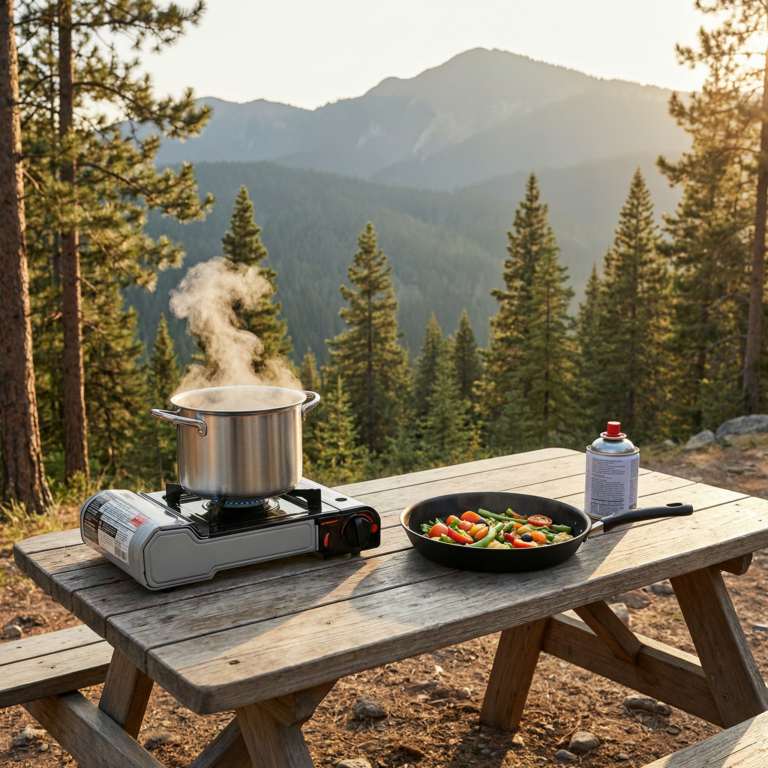
Cooking outdoors is one of the best parts of camping, but having the right cookware can make a big difference. Unlike a home kitchen, a campsite usually has limited cooking space, and you may need to carry your cookware from your vehicle to the campsite or even inside a backpack.
The best camping cookware should be durable, lightweight, compact, easy to clean, and versatile enough to prepare different types of meals. Whether you are making a quick breakfast, cooking dinner over a camp stove, or preparing a one-pot meal around the campfire, choosing the right pots and pans can make outdoor cooking much easier.
In this guide, we will look at the best types of camping cookware for outdoor cooking and explain how to choose the right options for backpacking, car camping, and family trips.
What Makes Good Camping Cookware?
Camping cookware needs to perform well without taking up unnecessary space.
Before choosing a cookware set, consider:
- Weight
- Durability
- Cooking performance
- Size
- Packability
- Ease of cleaning
- Material
- Number of people you are cooking for
- Type of meals you plan to prepare
For backpacking, lightweight and compact cookware is usually the priority. Car campers have more flexibility and can choose larger pots, pans, Dutch ovens, or complete cookware sets.
REI recommends considering your camping style, cookware materials, weight, storage space, and the type of meals you plan to prepare when building a camp kitchen.
1. Camping Cookware Set
A camping cookware set is one of the easiest options for outdoor cooking.
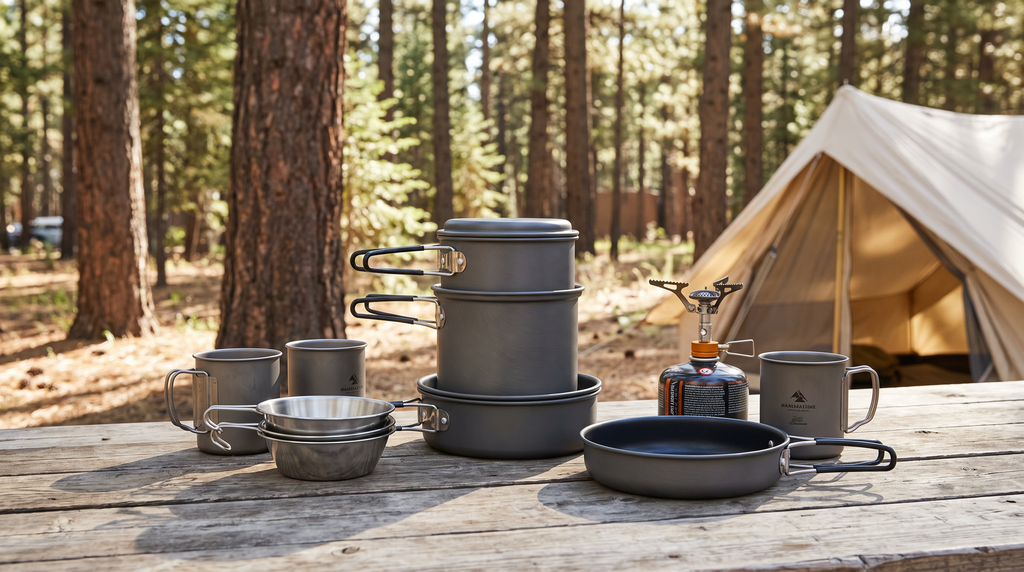
A typical set may include:
- Cooking pot
- Frying pan
- Pot lid
- Plates
- Bowls
- Cups
- Utensils
Many camping cookware sets are designed to nest together, allowing smaller pieces to fit inside larger pots. This can save valuable storage space.
A complete set is especially convenient if you are starting your camping kitchen from scratch or regularly cook for several people.
However, avoid buying an oversized set if you only need a pot and pan for simple meals.

2. Camping Cooking Pot
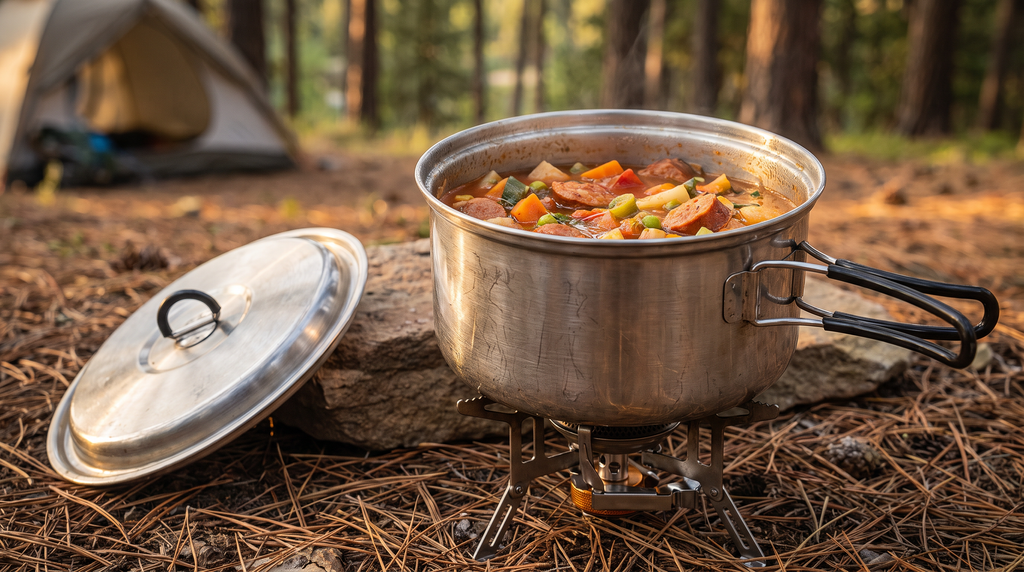
A cooking pot is one of the most important pieces of camping cookware.
You can use it to prepare:
- Pasta
- Rice
- Soup
- Chili
- Oatmeal
- Stews
- Dehydrated meals
- Boiling water
For backpacking, a smaller pot may be enough for one or two people.
For larger groups, choose a bigger pot that can handle the amount of food you normally prepare.
A lid is also useful because it can reduce cooking time and help conserve fuel. REI notes that lids can reduce cooking time and fuel use while also helping prevent splatter.
3. Camping Frying Pan
A compact frying pan is useful for breakfast and quick meals.
You can use it for:
- Eggs
- Pancakes
- Bacon
- Burgers
- Vegetables
- Fish
- Grilled sandwiches
If you already have a cooking pot, adding a frying pan can significantly expand your meal options.
Some camping cookware sets use a lid that can also function as a frying pan, which can help reduce the amount of equipment you need to carry.
4. Camping Dutch Oven
A Dutch oven is a popular choice for campers who enjoy traditional outdoor cooking.
It can be used for:
- Stews
- Chili
- Roasted meat
- Baked dishes
- Beans
- Slow-cooked meals
- Campfire desserts
Cast iron Dutch ovens are extremely durable and work well for campfire cooking.
The main disadvantage is weight. Cast iron is much heavier than aluminum or titanium, so it is generally better suited to car camping than backpacking.
For campers who want to prepare larger meals over a campfire, however, a Dutch oven can be an extremely versatile piece of cookware.
5. Camping Grill Pan
A grill pan can be useful if you enjoy cooking meat and vegetables outdoors.
It can help create grilled-style meals such as:
- Chicken
- Steak
- Burgers
- Vegetables
- Fish
Choose a compact model if storage space is limited.
If you already have a grill grate or outdoor grill, however, a separate grill pan may not be necessary.
The best camping cookware is usually the equipment that matches the meals you actually plan to prepare.
6. Camping Kettle
A small camping kettle is useful for quickly boiling water.
You can use it for:
- Coffee
- Tea
- Instant oatmeal
- Freeze-dried meals
- Hot chocolate
- Instant soups
For backpacking, a lightweight kettle can be useful when boiling water is one of your main cooking tasks.
For car camping, you may prefer a larger kettle or simply use your cooking pot.
7. Titanium Camping Cookware
Titanium cookware is popular among backpackers because it is extremely lightweight while remaining strong and corrosion-resistant.
Its main advantages include:
- Very low weight
- High strength
- Compact design
- Corrosion resistance
- Good portability
The main disadvantage is price. Titanium cookware is usually more expensive than basic aluminum cookware.
It also does not distribute heat as evenly as some other materials, so it is better suited to boiling and simple cooking than high-heat frying.
REI identifies titanium as one of the lightest cookware materials while noting that it is more expensive and does not distribute heat as evenly as stainless steel.
8. Aluminum Camping Cookware
Aluminum is one of the most common materials used in camping cookware.
It is popular because it is:
- Lightweight
- Affordable
- A good heat conductor
- Easy to carry
- Suitable for many types of camping
Aluminum cookware can be particularly useful for backpackers and campers who want a balance between weight and cooking performance.
The downside is that basic aluminum can dent or scratch more easily than stainless steel.
Hard-anodized aluminum is another option because it provides greater resistance to scratches and abrasion.
9. Stainless Steel Camping Cookware
Stainless steel is a good choice for campers who prioritize durability.
It is:
- Strong
- Scratch-resistant
- Long-lasting
- Easy to maintain
- Suitable for frequent outdoor cooking
The main disadvantage is weight. Stainless steel cookware is generally heavier than aluminum or titanium.
For car camping, this may not be a major issue because you do not need to carry the cookware long distances.
For backpacking, however, lighter materials may be more practical.
10. Cast Iron Camping Cookware
Cast iron is a classic choice for outdoor cooking.
It works particularly well over:
- Campfires
- Charcoal
- Outdoor grills
- Camp stoves
Cast iron is excellent for:
- Steaks
- Burgers
- Cornbread
- Stews
- Roasted vegetables
- Dutch oven meals
When properly seasoned, cast iron can also develop a naturally nonstick cooking surface.
The biggest disadvantage is its weight. Cast iron is significantly heavier than aluminum, stainless steel, or titanium, making it better suited to car camping.
11. Nonstick Camping Cookware
Nonstick camping cookware can make outdoor cooking and cleanup easier.
It is useful for foods such as:
- Eggs
- Pancakes
- Fish
- Vegetables
- Sticky sauces
However, nonstick coatings require more care because they can be scratched by metal utensils.
If you prefer nonstick cookware for everyday meals, you can also read our guide to Best Nonstick Cookware Sets for Everyday Cooking.
When using coated cookware outdoors, avoid overheating it and follow the manufacturer’s care instructions.
12. Collapsible Camping Cookware
Collapsible cookware can be useful when storage space is extremely limited.
Some designs can fold or collapse after cooking, making them easier to store inside a backpack, vehicle, or camping box.
Collapsible cookware can be particularly useful for:
- Small campers
- Van camping
- Road trips
- Minimalist camping
- Small kitchens
Before buying, check how stable the cookware is when expanded and whether it can safely be used over your chosen heat source.
13. Nesting Camping Cookware
Nesting cookware is designed so that pots, pans, cups, and other pieces fit inside each other.
This design can significantly reduce the space required to transport your cooking equipment.
A basic nesting setup might include:
- One large pot
- One small pot
- One frying pan
- One lid
- Cups
- Small utensils
For backpackers and campers with limited storage, nesting cookware is one of the most practical designs.
Complete cooksets commonly use nesting designs specifically to reduce the final packed size.
14. Camping Plates and Bowls
Although plates and bowls are technically dinnerware rather than cookware, they are important parts of a complete outdoor kitchen.
Choose options that are:
- Lightweight
- Durable
- Stackable
- Easy to clean
For solo camping, you may only need one bowl or plate.
For family camping, having one set per person makes serving meals much easier.
15. Camping Mug
A durable camping mug can be used for:
- Coffee
- Tea
- Hot chocolate
- Soup
- Other hot drinks
Metal or hard plastic camping mugs are popular because they are reusable and easy to clean.
If space is limited, choose a mug that can nest inside your cooking pot.
16. Camping Cookware With Folding Handles
Folding handles can make cookware significantly easier to pack.
Instead of having a long fixed handle sticking out from your backpack or storage box, the handle can fold against the cookware.
This is especially useful for:
- Backpacking
- Small tents
- Motorcycle camping
- Road trips
- Compact camping kitchens
When choosing folding-handle cookware, make sure the locking mechanism feels secure before cooking.
17. Pot Lid and Pot Gripper
A pot lid may look like a small accessory, but it can make outdoor cooking more efficient.
A good lid can:
- Reduce cooking time
- Help conserve fuel
- Keep heat inside
- Reduce splashing
A pot gripper or handle is also important because cookware can become extremely hot during cooking.
REI recommends making sure you have a safe way to pick up hot pots and pans and notes that many cooksets include a pot gripper.
Best Camping Cookware for Different Types of Camping
The best cookware depends heavily on the type of camping you are doing.
Best Cookware for Backpacking
Backpackers should focus on:
- Low weight
- Compact size
- Simple cooking
- Nesting designs
- Multi-purpose cookware
A basic setup could include:
- Small titanium or aluminum pot
- Pot lid
- Spork
- Small cup
- Compact stove
For simple dehydrated meals, you may only need one small pot for boiling water.
The USDA also recommends planning meals and equipment in advance and notes that backpackers often need to consider the weight of their food and supplies carefully.
Best Cookware for Car Camping
Car campers have more freedom when choosing cookware.
A practical setup could include:
- Large cooking pot
- Frying pan
- Dutch oven
- Kettle
- Cooking utensils
- Plates
- Bowls
- Mugs
Because the cookware does not need to be carried long distances, durability and cooking performance can become more important than minimizing every gram.
Best Cookware for Family Camping
For family camping, look for larger cookware sets that can prepare several servings at once.
Useful pieces include:
- Large cooking pot
- Frying pan
- Dutch oven
- Large serving spoon
- Spatula
- Tongs
- Plates
- Bowls
- Mugs
A complete nesting cookware set can be especially convenient for families because multiple pieces can be stored together.
How Much Camping Cookware Do You Need?
You do not need a complete kitchen for every camping trip.
For one or two people, a simple setup might include:
- One cooking pot
- One frying pan or pot lid that doubles as a pan
- One cooking spoon
- One spatula
- One pair of tongs
- One mug
- One bowl
- One spork
For larger groups, add larger pots, serving utensils, plates, bowls, and additional cookware.
The USDA recommends planning what you will eat and how you will prepare it before deciding what equipment to take.
What Camping Cookware Material Is Best?
There is no single best material for every camper.
Titanium
Best for: Backpacking and ultralight camping.
Pros:
- Extremely lightweight
- Strong
- Corrosion-resistant
Cons:
- More expensive
- Less even heat distribution
Aluminum
Best for: Lightweight camping on a budget.
Pros:
- Lightweight
- Affordable
- Good heat conduction
Cons:
- Can dent or scratch more easily
Hard-Anodized Aluminum
Best for: Campers looking for a balance between weight and durability.
Pros:
- Lightweight
- Durable
- Better scratch resistance
Cons:
- Usually more expensive than basic aluminum
Stainless Steel
Best for: Durable car-camping cookware.
Pros:
- Strong
- Scratch-resistant
- Long-lasting
Cons:
- Heavier
- Can develop hot spots
Cast Iron
Best for: Campfire cooking and Dutch oven meals.
Pros:
- Extremely durable
- Excellent for high-heat cooking
- Great heat retention
Cons:
- Very heavy
- Requires more maintenance
These trade-offs are consistent with REI’s comparison of common camping cookware materials.
Camping Cookware vs Regular Kitchen Cookware
You may wonder whether you can simply take cookware from your home kitchen camping.
Sometimes you can, especially for car camping.
However, camping cookware is generally designed to be:
- More compact
- Easier to transport
- More durable
- Easier to store
- Better suited to portable stoves and outdoor cooking
For backpacking, regular kitchen cookware is usually too bulky or heavy.
For car camping, however, some home cookware can work perfectly well if it is compatible with your heat source.
How to Choose the Right Camping Cookware
Before buying cookware, ask yourself these questions:
1. How many people will you cook for?
A solo camper needs much less cookware than a family of six.
2. How will you travel?
If you are backpacking, weight is critical.
If you are driving directly to your campsite, you can choose larger cookware.
3. What will you cook?
Simple dehydrated meals require very little equipment.
Pancakes, steaks, stews, and multi-course meals require more cookware.
4. What heat source will you use?
Make sure your cookware is appropriate for your:
- Portable stove
- Gas burner
- Campfire
- Grill
- Charcoal setup
Also check campsite rules before planning to cook over an open fire, since some camping areas restrict or prohibit campfires.
5. How much storage space do you have?
Nesting cookware and folding handles can make a big difference when space is limited.
How to Clean Camping Cookware
Cleaning your cookware after every meal is important, especially when preparing meat, poultry, eggs, or other perishable foods.
Bring:
- Biodegradable dish soap
- Sponge
- Scrubber
- Clean water
- Dish towel
- Hand sanitizer
The USDA recommends bringing soap and water or hand sanitizer containing at least 60% alcohol when running water is unavailable. It also recommends keeping raw foods separate and avoiding cross-contamination between raw and cooked foods.
Never assume that water from a lake or stream is safe for drinking, cooking, or cleaning. Bring safe water or use an appropriate treatment method.
Camping Cookware Food Safety Tips
Outdoor cooking requires a little extra planning.
When cooking meat or poultry:
- Keep raw food separate from cooked food
- Wash your hands before and after handling food
- Use clean utensils
- Keep perishable food cold
- Use a food thermometer when appropriate
- Clean cookware after use
The USDA recommends using a food thermometer because color alone is not a reliable way to determine whether meat is safely cooked.
For example, USDA recommends cooking ground beef, pork, lamb, and veal to 160°F, while poultry should reach 165°F internally.
Camping Cookware Packing Checklist
Before your next outdoor adventure, use this checklist.
Essential Cookware
- Cooking pot
- Pot lid
- Frying pan
- Pot gripper
- Cooking spoon
- Spatula
- Tongs
- Knife
- Cutting board
Optional Cookware
- Dutch oven
- Camping kettle
- Grill pan
- Collapsible cookware
- Measuring cup
- Measuring spoons
- Mixing bowl
- Coffee maker
Eating Equipment
- Plates
- Bowls
- Cups
- Mugs
- Sporks
- Forks
- Spoons
Cleaning Equipment
- Biodegradable dish soap
- Sponge
- Scrubber
- Dish towel
- Clean water
- Hand sanitizer
- Waste bags
REI’s camp kitchen checklist similarly includes cookware, cooking utensils, cutting tools, cleanup supplies, storage, and food basics as core parts of a complete camp kitchen.
Final Thoughts
The best camping cookware for outdoor cooking is the cookware that matches your camping style, cooking habits, and available space.
For backpacking, a lightweight titanium or aluminum pot with a lid and a compact eating utensil may be enough. For car camping, you can choose a larger cookware set with a frying pan, Dutch oven, kettle, and additional serving equipment.
When choosing camping cookware, focus on weight, durability, material, cooking performance, packability, and ease of cleaning.
Most importantly, plan your meals before buying or packing your cookware. This helps you avoid carrying unnecessary equipment while making sure you have everything needed to prepare your meals comfortably outdoors.
If you are building a complete camp kitchen, you can also read our guide to Essential Kitchen Tools to Pack for a Camping Trip and our guide to Best Portable Cooking Utensils for Camping for additional ideas.
Frequently Asked Questions
What is the best cookware for camping?
The best cookware depends on your camping style. Lightweight titanium or aluminum cookware is ideal for backpacking, while stainless steel, hard-anodized aluminum, or cast iron can work well for car camping.
Is stainless steel good for camping?
Yes. Stainless steel is durable and scratch-resistant, making it a good option for campers who prioritize long-term durability. The main drawback is that it is heavier than aluminum or titanium.
Is titanium cookware worth it for camping?
Titanium can be worth it for backpackers because it offers very low weight with good strength. However, it is usually more expensive and does not distribute heat as evenly as some other materials.
Do I need a Dutch oven for camping?
No. A Dutch oven is optional. It is particularly useful for campers who enjoy cooking stews, baked dishes, roasted meats, and other meals over a campfire.
How many pots do I need for camping?
For simple meals, one pot may be enough for one or two people. Larger groups or more complicated meals may require multiple pots and a frying pan.
Can I use normal cookware for camping?
Yes, especially for car camping, as long as the cookware is suitable for your heat source. However, camping cookware is usually more compact, portable, and easier to store.
What should I look for in a camping cookware set?
Look for a set that is lightweight, durable, easy to clean, compact, and appropriate for the number of people you normally cook for. Nesting pieces and multi-purpose lids can also save space.
How do I keep camping cookware clean?
Use clean water, biodegradable dish soap, and a sponge or scrubber. Keep utensils and cookware used for raw meat separate from clean equipment and follow local campsite rules for wastewater disposal.
What is the best camping cookware for a family?
A larger nesting cookware set with at least one large pot, frying pan, lid, and serving utensils is usually a practical choice for family camping. The exact size should depend on the number of people and the meals you plan to prepare.